
Give Atidot a goal. Its agents read your history, pressure-test the assumptions with you, and roll a forecast forward you can act on, then sharpen it every cycle.
Seasonal, volatile demand and sprawling catalogs defeat spreadsheet models, and the cost shows up as the wrong inventory in the wrong places.
Fast movers, slow movers, make-to-order, new launches and long-tail SKUs each behave differently, one statistical method can’t fit them all.
Competitive moves, pricing shifts and seasonality rarely make it into the forecast, so surprises land as stockouts and overstock.
Teams firefight after the fact. By the time the exception is obvious, the window to act has already closed.
Forecasting tools have existed for decades. Atidot runs the loop for you with a team of agents, closing the gap between a prediction and a decision.
Horizon-aware predictions per SKU across the full catalog, short-term purchasing and long-range planning from one model.
Exceptions surface on their own, each with a plain-English action, what to order, when, and why.
The system evaluates its own forecasts and tracks per-SKU accuracy, so quality is measured, not assumed.
Planner feedback feeds back into the model, so recommendations get more useful every cycle.
Browse accuracy by horizon, review exceptions with recommended actions, and drill into any item, delivered into the tools your team already uses.

Actuals against forecast, filterable by horizon, product, customer and period, with the diagnostics to tell a good forecast from a fragile one.

Every flagged item arrives with a plain-English recommendation, a confidence level and the expected impact, so review time goes to decisions, not hunting.
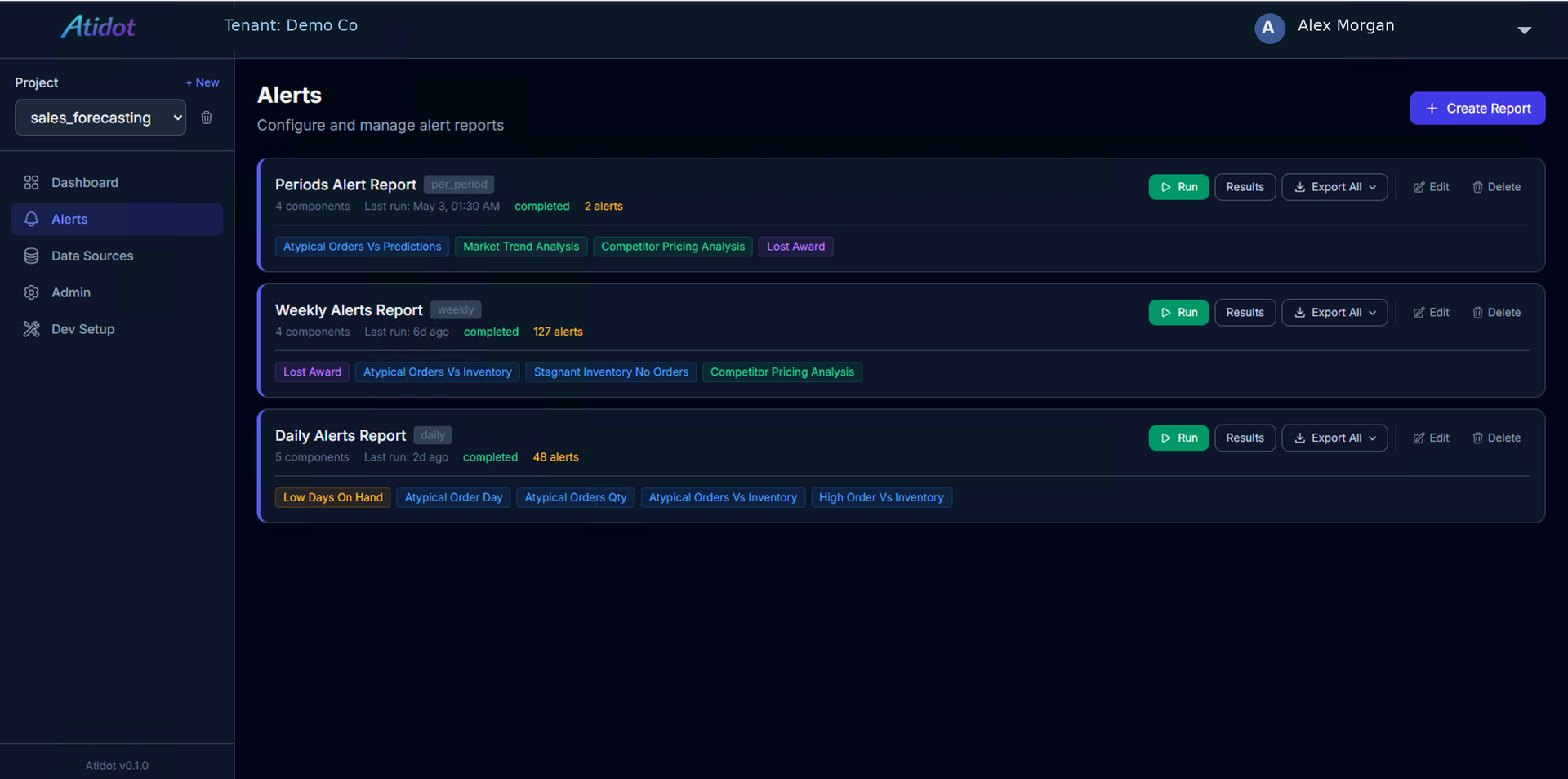
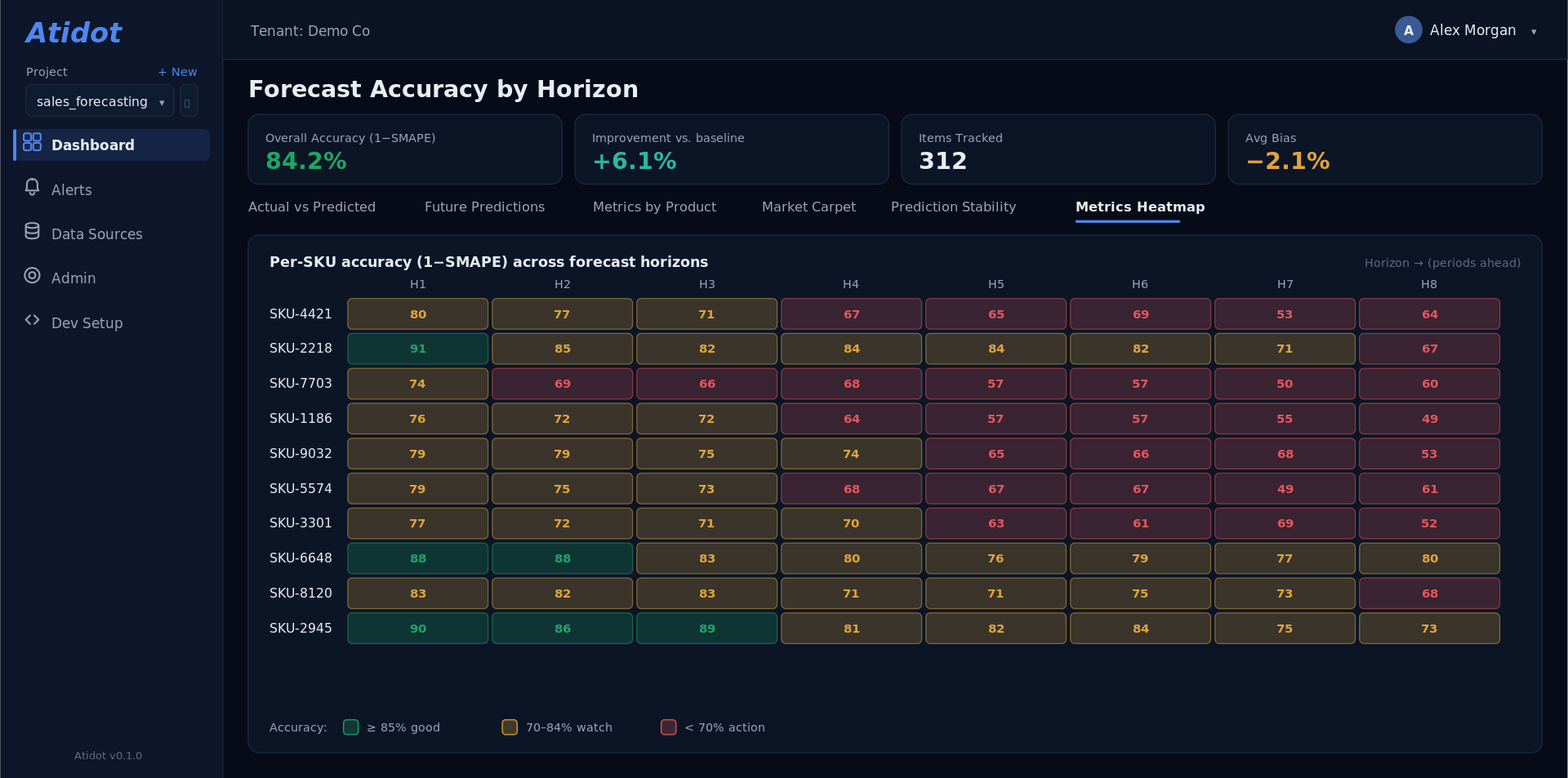
Forecasts, recommends, reflects, and learns from planner feedback. Most tools forecast and stop.
Weekly out to a year and period-level planning together, purchasing and production aligned.
Fast movers, slow movers, make-to-order, discontinued and new launches, each on its own terms.
Exceptions come to you, each with a recommended action, not just a red flag.
Competitive events, pricing and seasonality treated as model inputs, not afterthoughts.
A web app with alerting, accuracy tracking and ongoing model management, cloud or on-premise.
Built for operations and supply-chain teams where standard tools run out of road.
In production with a global pharmaceutical manufacturer, forecasting 400+ SKUs across 100+ customers, with daily and weekly exception reports delivered straight into their existing BI.
A global pharmaceutical manufacturer moved from fragmented forecasting inputs to a production decision layer spanning its full site portfolio. Anonymized at the customer’s request.
Forecasting signals were fragmented across several sources, lower-volume long-tail SKUs were reviewed only periodically, and alerts stopped at detection, flagging issues without a next action.
Full-portfolio forecasting by SKU and customer, in quantity and value, combining orders, shipments, inventory, pricing, contracts and market data, with every exception arriving as a recommended action.
Forecast error fell by ~60%. Accuracy rose from 72% to 88% at H1 and 68% to 88% at H4, reaching 85.4% at H12, and ~73% of SKUs improved across the portfolio.
400+ SKUs and 100+ customers forecast 24 periods ahead on 5+ years of history, delivered into the team’s existing BI and live in 2 to 3 weeks.
The full 2-page story, ready for your team to forward internally.
You see value before you commit — clear phases, on your live planning cycles.
You share history for an agreed SKU set. We confirm access, scope and success criteria — no systems to rip out.
A rolling-window backtest on your own data. We show you, SKU by SKU, where the current forecast is losing money.
Forecasts and weekly exception reports flow into your BI on real planning cycles, with per-SKU accuracy tracked throughout.
Commercial model: an annual SaaS license plus a one-time implementation. We scope pricing to your catalog and integration during the pilot conversation.
The questions planning and IT teams ask us first.
Whatever you already have. Atidot ingests CSV/Excel uploads, ERP exports, and direct connections to SQL / data-warehouse tables (SQL Server, MySQL, PostgreSQL), SharePoint and cloud storage (Azure Blob, S3). We meet your data where it lives — no re-platforming to get started.
A typical pilot runs in named phases: a Week-0 data drop, a backtest and audit readout in Weeks 1–2, then an 8–12 week pilot on live planning cycles. Commercially it’s an annual SaaS license plus a one-time implementation; we scope the numbers to your catalog and integration during the pilot conversation.
Both. Atidot runs in the cloud or on-premise / inside your own VPC. Your data can stay in your environment — deployment is chosen to fit your security and IT requirements.
Augment. Atidot reads from and writes back to your existing stack via files or API and delivers forecasts into the BI and planning tools your team already uses. It strengthens your current process rather than forcing a rip-and-replace.
No. Atidot is built for planners and supply-chain domain experts. The platform manages the forecasting models — configuration, tuning, backtesting and ongoing model management — so your team works with recommendations and accuracy, not notebooks.
Per-SKU, across horizons. Atidot uses rolling-window backtesting and tracks actual-vs-predicted and total deviation continuously, so forecast quality is measured over time, not assumed — and you can see exactly where the model is strong or fragile.
Tell us a little about your catalog and what’s hard today. We’ll follow up directly, no funnel.